On Tusday and Wednesday, members of the Imperial royal family visited Meiji Jingu Shrine to commemorate the 110th anniversary of the death of Empress Shoken. Empress Michiko wore a small embellished saucer, Crown Princess Kiko wore a bumper design while Empress Masako and Princess Aiko both wore ivory silk hats with upturned brims.
April 9: Crown Prince Akishino and Crown Princess Kiko visited Meiji Jingu in Shibuya, Tokyo to commemorate the 110th anniversary of the death of Empress Shoken. 📹 https://t.co/t5oUiIoRwKpic.twitter.com/U6RhNIgdvm
On Thursday, Infanta Elena wore a casual fedora to visit her mother, Queen Sofia, in hospital in Madrid.
11-04-2024 Infanta Elena leave by car the Hospital Ruber Internacional in Madrid after visiting Queen Sofia who has spent her second night in the hospital for a urinary infection. pic.twitter.com/K2pBD4m02Y
— News about Queen Maxima and Royal Ladies (@vaninaswchindt) April 13, 2024
Also On Thursday, Princess Aiko wore a brimless ecru hat with decidedly 1960s vintage vibes for a visit to her grandparents.
Princess Aiko visits the Akasaka estate in Tokyo on April 11, 2024, to meet with Emperor Akihito and Empress Michiko, her grandparents, after she recently started working at the Japanese Red Cross Society's headquarters in the capital. pic.twitter.com/Q1vVTQM6ls
— News about Queen Maxima and Royal Ladies (@vaninaswchindt) April 12, 2024
Princess Kako wore an ivory silk covered bumper hat with back bow yesterday for a visit to Meiji Shrine.
FNN gallery: Princess Kako visited Meiji Jingu in Tokyo on April 12, 2024 to mark the 110th anniversary of the death of Empress Shoken.https://t.co/6rU07lxVET
The Duke of Edinburgh, as Commodore in Chief of the Royal Fleet Auxiliary, welcomed RFA Stirling Castleinto the Naval Fleet yesterday in Leith, Scotland.
Today, Hereditary Prince Alexander and Hereditary Princess Hande of Mecklenbur christened their son, Duke Leoplold. Princess Ande wore a white bumper percher hat.
Duke Leopold, the son of Hereditary Prince Alexander and Hereditary Princess Hande, was baptised today at the Church of Our Saviour in The Hague
We continue extended series on different royal hats that have been worn on visits to Washington, D.C. researched and written by Jake Short, longtime reader, hat aficionado (follow him on Instagram or Twitter) and dear friend of Royal Hats. Jake, it’s so great to have you back for the fifth post in this series!
Outside of politics, the National Mall, and the Smithsonian museums, Washington, DC is perhaps best known for its annual cherry blossom festival. Every spring the city comes alive to celebrate, decking itself in pink and white as the Yoshino Sakura cherry trees bloom along the Tidal Basin, at the National Arboretum, and elsewhere. While the crowds can be overwhelming and annoying, the cherry blossoms here truly are a sight to behold (even though I am a night owl, I highly recommend going for sunrise). Last year was the 110th anniversary of this gift of the cherry blossom trees from Japan. Therefore, we are now going to look back at the Japanese royal hats for this installment of the series. I have tried to follow the Japanese naming system of last name, first name as much as possible; all errors are my own, and I apologize in advance for them.
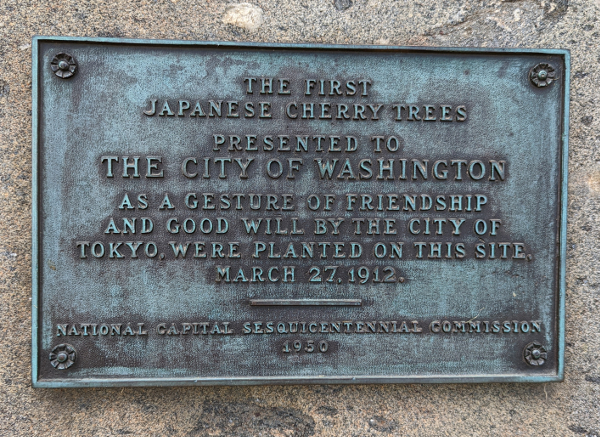
The cherry blossoms planted around the Tidal Basin were a gift from Mayor Ozaki Yukio of Tokyo in 1912. In 1910, the mayor was part of a Japanese delegation that visited DC, led by Prince Tokugawa Iesato. This trip was linked with the gifting of 2,000 cherry trees, but they unfortunately arrived diseased and had to be destroyed. Dismayed at this, a second gift of 3,020 saplings were sent in 1912; the original idea of having cherry trees originated with Eliza Ruhamah Scidmore after she had visited Japan in 1885 and had experienced the beauty of their blossoming herself. On 27 March 1912, US First Lady Helen Herron Taft and Viscountess Chinda Iwa, wife of the Japanese Ambassador to the US (seen in a floralEdwardian hat with veiling in this photo sometime around 1920), planted the first trees in a small ceremony that unfortunately seems to have no surviving photographs I could find, if any were taken at all.
In 1965, First Lady Claudia “Lady Bird” Johnson recreated this ceremony with the Japanese ambassador’s wife by starting the planting of an additional 3,800 Yoshino cherry trees; Lady Bird Johnson wore a black Breton style hat for the event. The only royal hats I’ve found directly with the cherry blossoms have been the light colored hat with floppy eyelet brim worn by Kikuko, Princess Takamatsu and the fur felt fedora worn by Nobuhito, Prince Takamatsu (brother of Emperor Hirohito [Shōwa]), when they visited on 16 April 1931.
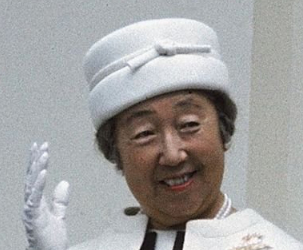
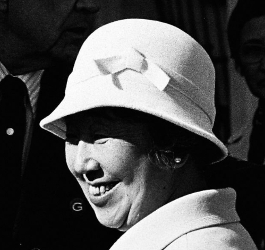
Due to the isolationism of Japan until the 19th Century then being on the opposing side in World War II, it’s not surprising Prince Tokugawa Iesato was one of the only Japanese royals to visit the US before 1945. In the second half of the 20th Century and into the beginning of the 21st Century, such visits have become more frequent. In 1965, Prince and Princess Mikasa visited the DC Chapter of the American Red Cross. Princess Yuriko can be seen in a floral covered 1960s style cloche, while her daughter Princess Yasuko (sister-in-law to Princesses Nobuko and Hisako) wore a white Breton hat.
12 years later almost to the day after the visit of his parents, then-Crown Prince Akihito and Crown Princess Michiko visited DC. For their arrival at Joint Base Andrews on October 5, 1987, Crown Princess Michiko wore a black pillbox with flower. She changed for the America-Japan Society luncheon later that day to a percher cocktail hat with a stylized bow trim, presumably in the same color and fabric as her skirt suit.
During their third day in DC, they visited Walt Whitman High School in Bethesda, Maryland (a DC suburb), to observe Japanese classes; Michiko wore a third stylized boater placed like her signature saucer hats we are familiar with.
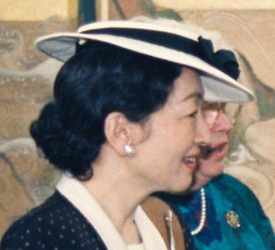
In 1994, Akihito and Michiko returned to DC, this time as Emperor and Empress. They arrived at their accommodation at Blair House, across the street from the White House, with the Empress wearing a signature wide disc hat with a bouquet of small flowers for trim.
As they left Blair House on 15 June at the end of their visit to DC, the Empress wore another small percher hat while Secretary of State Warren Christopher gave them the official goodbye.
Unfortunately, there has not been an official visit to DC by Japanese royals since 1994. I hope this will change in the near future and we’ll get a visit from Emperor Naruhito and Empress Masako, but I would also welcome a visit from my personal favorite Japanese royal: Princess Hisako (come visit our cherry blossoms!).
Post-scripts: In a royal-adjacent and DC-adjacent hat was Owada Yumiko, mother of Empress Masako, when she and Owada Hisashi greeted Akihito and Michiko in New York City during their 1994 US visit. Masako’s father was then the Japanese Ambassador to the United Nations. Yumiko is wearing a camel-colored felt hat with a large bejeweled hat pin.
Thank you, Jake, for another well researched post! I didn’t know the history and Japanese connection to the Washington DC cherry trees and this was most insightful. And dare I say, your cherry hued fedora is as stunning as any royal hat! Thank you so much for this series.
On Thursday, the Luxembourg grand ducal family celebrated their country’s national holiday. Hereditary Grand Duchess Stéphanie repeated a fuchsia sinamay rolled edge headpiece studded with white silk flowers (she wore it to this same event in 2014) while Princess Alexandra repeated an ecru embellished flapper style headpiece with acid green silk flower on the side.
On Friday, Queen Margrethe presented the “Queen’s Clock” military award and on Saturday, she opened a museum about flight in Oksboel. She repeated pink hats for these events.
Wishing Empress Michiko a happy 87th birthday today with a look back at one of her hats. This layered turban was worn to the Tokyo Olympics on October 21, 1964 speaks very much to the fashion of the times (the layers are a lovely touch). And of course, a nod must be given to the most darling cap on young Prince Naruhito!
I’m so pleased to welcome back longtime reader, hat aficionado (follow him on Instagram or Twitter) and friend of Royal Hats, Jake Short, for the fourth post in a 5-part series on the history and hats of the Ethiopian Imperial Family (see Part 3 here).
Haile Selassie visited the Netherlands in 1954 and was photographed holding a plumed ceremonial military hat while Queen Juliana wore a calot with swooping feather trim.
During this visit, these wonderful photos were captured with the Emperor in his military cap and Queen Juliana in turbans- one covered in pleated ruffles and the other, smooth.
King Paul and Queen Frederika of Greece visited Addis Ababa in 1959. Here they are seen with the Emperor and Empress, all wearing hats suited to their rank and typical for that time.
Again in his military cap, Haile Selassie is seen with other royals at a ceremony in Iran in 1971 to celebrate 2,500 years of the Persian Empire; Queen Fabiola and King Baudouin of Belgium (with Princess Anne of the UK behind them), Queen Ingrid and King Frederik of Denmark, Queen Anne-Marie of Greece (behind Emperor Haile Selassie), and Shah Reza Pahlavi and Shahbanou Farah Diba of Iran can be seen wearing hats (many more royals were also in attendance at this grand event).
Relations with the Japanese Imperial Family, another reigning imperial family, were cordial and saw multiple visits. Haile Selassie visited Japan in 1956 with his eldest daughter Princess Tenagnework (seated, wearing a veiled calot), her daughter Princess Aida Desta (wearing a feathered casque hat), and Prince Makonnen, Duke of Harar. Crown Prince Asfaw Wossen and Crown Princess Medferiashwork visited Japan in 1959; while neither wore hats during a duck hunting session, their hosts Crown Prince Akihito and Crown Princess Michiko did. Crown Princess Medferiashwork was seen during this same visit in a toque-like hat during a visit to a department store.
Crown Prince Akihito and Crown Princess Michiko visited Ethiopia in 1960, with Akihito (carrying a top hat) being formally received by Emperor Haile Selassie at the airport. Crown Princess Medferiashwork wore a calot while she and Michiko visited a girls’ school; Medferiashwork was later seen in a headscarf when she accompanied Michiko and Akihito (both in hats) on a visit to Mt. Entoto just north of Addis Ababa.
Finally, there were multiple interactions with the British Royal Family. A 1954 state visit to the UK by the Emperor and his son the Duke of Harar began at Victoria Station, where Queen Elizabeth II greeted Haile Selassie, who wore a ceremonial military hat trimmed with lion’s mane!
The Queen Mother, Princess Margaret, Princess Mary, and Princess Alice, the Duchess of Gloucester, who all wore calots typical of the mid-1950s.
A 1965 visit to Ethiopia by the Queen and Prince Philip saw only military hats from the host royals (the Empress had died in 1962, and there is a lack of photos of other female royals to determine their level of participation in the visit).
Another informative post, Jake- thank you! The Ethiopian princesses’ calots and half hats during the Japanese visit (and reciprocal visit five years later) are beautiful examples of fashion of the time! It’s also a fascinating reminder how millinery styles changed (inflated!) from the 1950s to the 1960s! How well did Queen Juliana’s cream turban pair with her 1960s sunglasses?! Such a fun look!
Jake returns next week for the final post in this series.








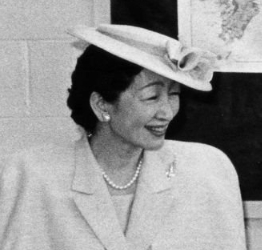


 Wishing Empress Michiko a happy 87th birthday today with a look back at one of her hats. This layered turban was worn to the Tokyo Olympics on October 21, 1964 speaks very much to the fashion of the times (the layers are a lovely touch). And of course, a nod must be given to the most darling cap on young Prince Naruhito!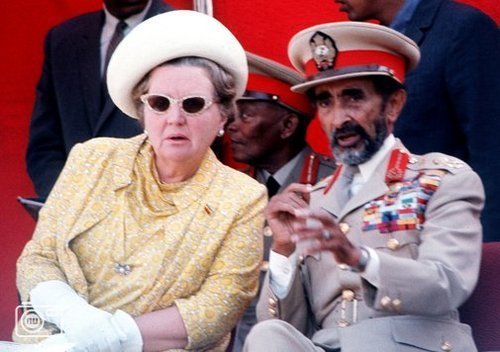
 Royal Hats


.jpg)