 to 1984 and a clearly joyful royal couple enjoying an amusement park ride. I adore how Queen Margrethe is hanging on to her hat.
Photo from Getty as indicated

to 1984 and a clearly joyful royal couple enjoying an amusement park ride. I adore how Queen Margrethe is hanging on to her hat.
Photo from Getty as indicated
On Tuesday, Queen Margrethe opened the royal yacht Dannebrog’s sailing season in her repeated navy felt hat with silk hatband that ties in a side bow. With her navy suit, red and white blouse and anchor brooch, the hat topped a suitably (but not to obviously) nautical ensemble.
I’m so pleased to welcome Denmark-based Dutch freelance journalist Inger Stokkink back to Royal hats for the second part of her review on the exhibit on Queen Margrethe’s fashion at Den Gamle By Museum in Aarhus. If you missed the first part of her article, jump over to this post to catch up.
Royal Hats of Queen Margrethe of Denmark (continued)
by Inger Stokkink
ACTIVELY DESIGNING ALONG
Queen Margrethe has been known to actively take part in the designing process with her designers, especially gala gowns, or ’big dresses’ as the Queen calls them. Festive gowns for royals have requirements and little tricks that do not play a role in the lives of lesser mortals. Orders, medals, and chains that are worn for ceremonial purposes, along with large pieces of jewelry need to be incorporated in the design. The inclusion of these items must happen not only visually but also in a practical and structural sense – they can be so heavy that they weigh down the textile, thereby ruining design, material, drape and silhouette.
Embed from Getty Images Embed from Getty Images Embed from Getty Images
Embed from Getty Images Embed from Getty Images Embed from Getty Images
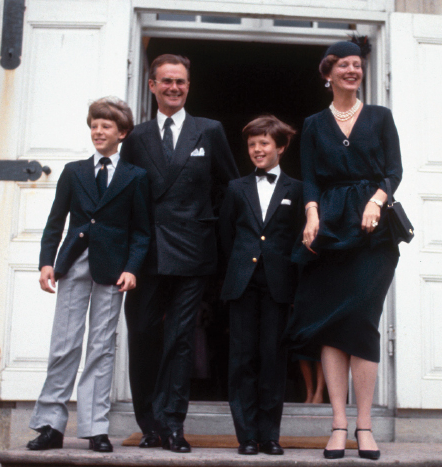
These considerations do not play a substantial role in the design of royal hats, yet the Queen has plays an active role in the design process here, too. Tove Mathiassen points out a black calot hat, saying, ”We know for a fact that the Queen has been an active co-designer of both dresses and suits. And about one of the hats in the exhibition, the Queen has told that it first was worn at the occasion of the Crown Prince’s konfirmation in 1981 and later had added red flowers. ”
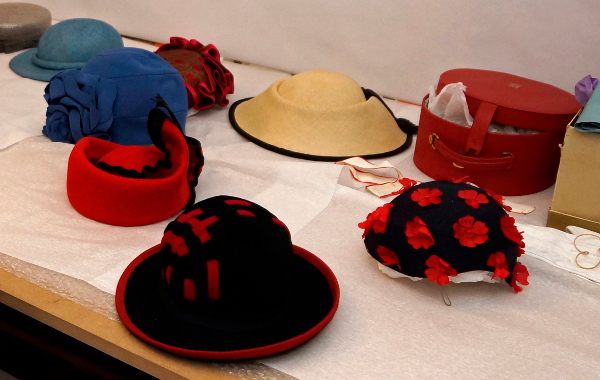
Black calot hat with red flowers, above right; in its original form, below, on May 28, 1981 at Prince Frederik’s confirmation with a black feather pouf on the side
The hats themselves – on their own, so to speak – do miss their bearer and her clothes to bring the designs to life. Illustrations or photographs of the Queen wearing them would have helped the exhibition here. On the other hand: how much closer can you get to so many royal hats?
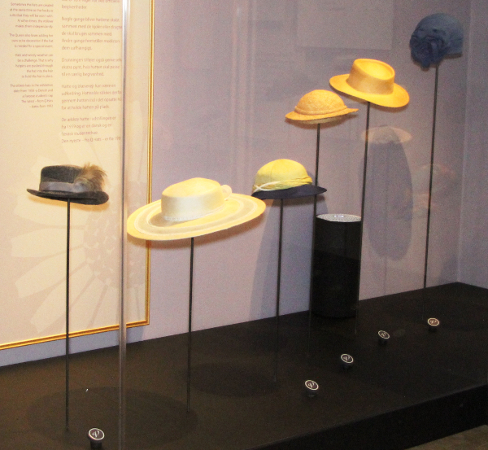
Cream straw wide brimmed boater with inset crin stripe on the brim second from left above, and in action below, at Queen Margrethe and Prince Henrik’s silver wedding anniversary celebrations on June 10, 1992
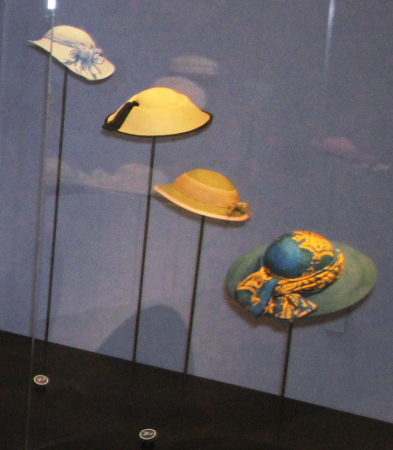
Pale blue straw football shaped saucer variation with silk crepe binding, hatband and floral trim pictured in the exhibition at top left above, and in closeup with curator Tove Engelhardt Mathiassen, below
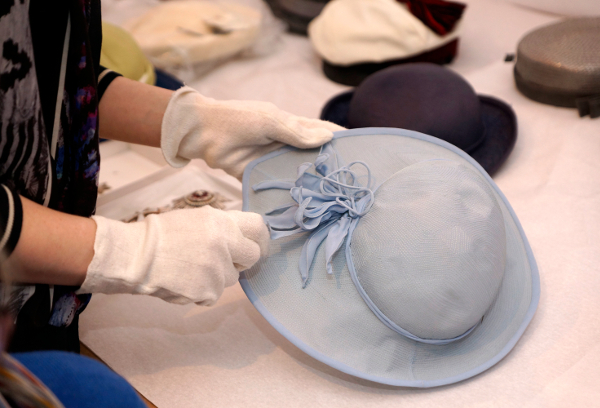
The hat in action (bottom left) on July 29, 1981 at the high profile wedding of Prince Charles and Lady Diana Spencer
STUDENT’S CAP
Not only ’grown-up’ hats are on display. There is a special place for the type of hat that almost every Danish high school student shares with the Queen: the studenterhat worn during graduation festivities. The Queen has two: a Danish one, and one from the Faeroe Islands, with an extra tassle, and a beautifully monogrammed red-leather hatbox to go with them.

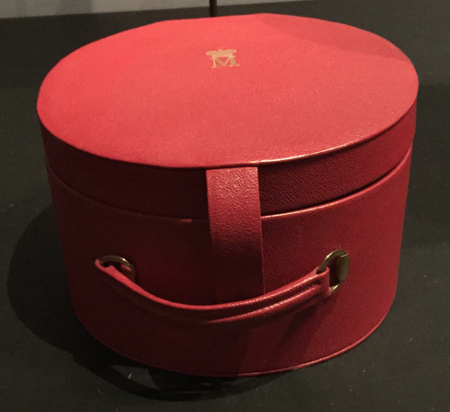
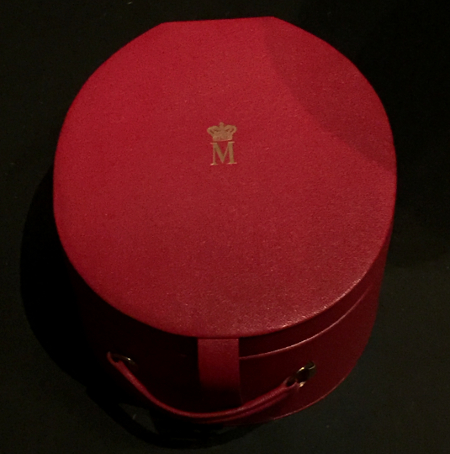
Should you wish to see these 42 hats for yourselves, visit Den Gamle By, the historical museum in the Danish town of Aarhus. The exhibition runs until September 9 this year and has two sections: gala dresses, and the dresses and suits she wore on her numerous visits around Denmark. The latter also includes some of her children’s clothes, a bicycle, and hats she made for performances of her friend’s Susanne Heering’s ballet school Fru H’s Danseinstitut. If you have already seen the Queen’s dresses at the Frederiksborg exhibition in 2015, then you won’t find anything new – apart from the hats, of course.
If you read Danish, much about the Queen’s hats can be found in the book ’Dronningens Kjoler’ (The Queen’s Dresses) by Katia Johansen (2012, Gyldendal Publishers), pp. 100-105.
Inger- this has been such an insightful look at Queen Margrethe’s approach to fashion and millinery! The photos in this post alone show saucers, Bretons, unusual pillbox variations, wide brims, cloches and others that together, display a wonderful diversity of scale, material and trim. Thank you for taking the time and effort to share this exhibition with all of us who are unable to attend. It really has been the most wonderful gift.
Photos from Miguel Mielgo and Inger Stokkink may not be replicated in any way without written permission.
Inger Stokkink is a Dutch freelance journalist living in Denmark. She divides her attention between politics, sailing and royalty – and hats.
When a new exhibition on Queen Margrethe’s gowns and hats opened several weeks ago in Aarhus, there was a collective sigh of disappointment from many readers who are unable to attend. Inger Stokkink is a Dutch freelance journalist living in Denmark. She divides her attention between politics, sailing and royalty – and hats. She recently took in the exhibition and generously shares her reflections with us in two parts, today and tomorrow. I’m thrilled to feature Inger here at Royal Hats.
Royal Hats of Queen Margrethe of Denmark
by Inger Stokkink
Forty-two hats, no less. The recently opened exhibition of Queen Margrethe’s gowns at Den Gamle By Museum in the Danish city of Aarhus follows an international trend where museums and royal families co-operate to share highlights of royal wardrobes with the greater public. But this exhibition is special because it comprises a sub-exhibition of royal hats.
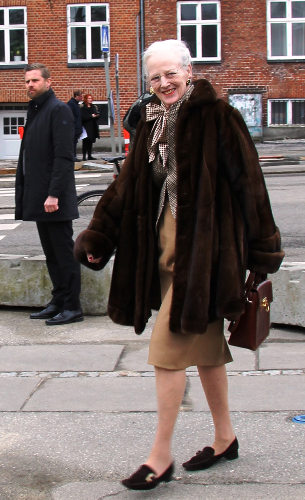
Queen Margrethe opening the fashion exhibition on March 27
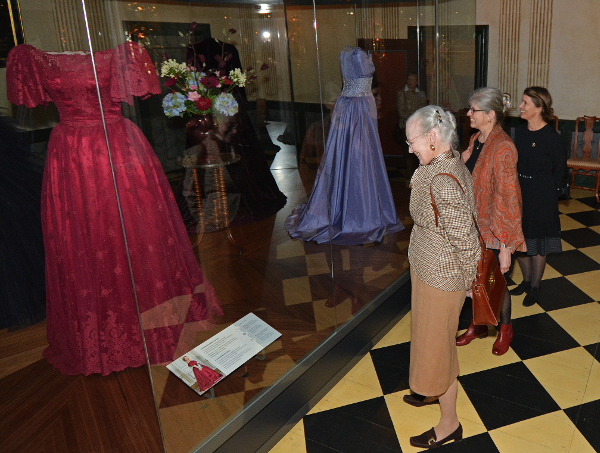
When curator Tove Engelhardt Mathiassen prepared the exhibition with the Danish court, she received the offer to include forty-two hats the Queen acquired in the sixties and seventies – an offer Tove immediately accepted.
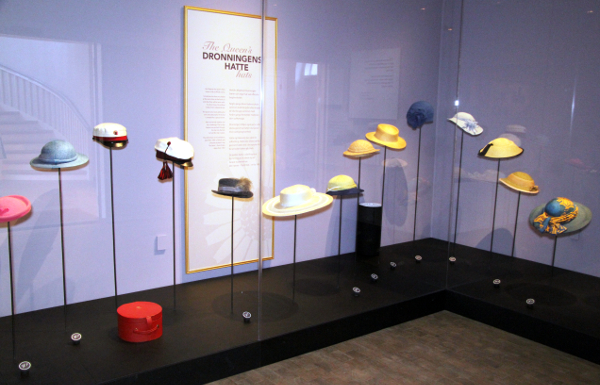
Most of the hats come from Vagn Hattesalon, a well-known and well-reputed hat shop in Copenhagen, active from 1910 til 1980. See here for a range of Vagn designs from the fifties and sixties.
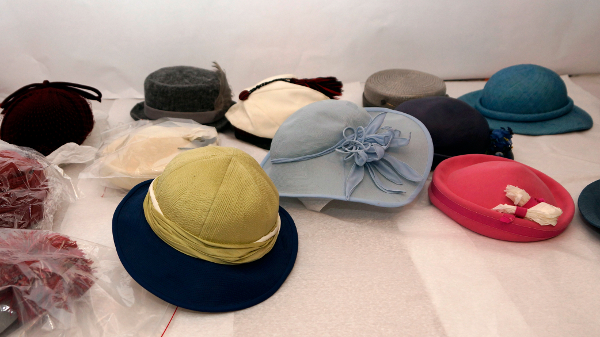
”The hats we have on loan from the queen are from the seventies up to the early eighties, when Vagn Hattesalon closed,” says Tove Mathiassen. ”It is remarkable how different the hats from Vagn are in form, colour and decoration. Some are very simple, with just a hat band or a single feather. Others are true little works of art, with flowers, feathers and veils.”
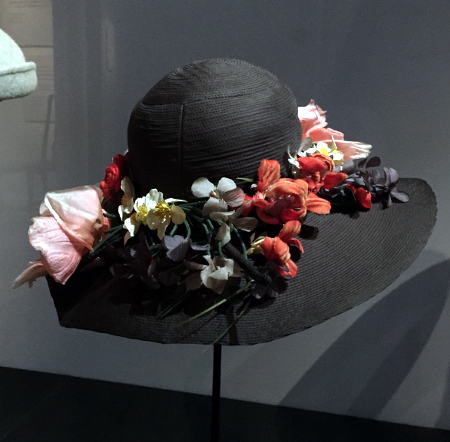
Black straw hat with flower trim worn by Queen Margrethe on May 2, 1974 during a trip to London
CUT FROM THE SAME CLOTH
Queen Margrethe has an active role in the design of her clothes, and the same goes for her hats. Frequently, she has sent the same material used to make a dress or other garment to her hat maker with the suggestion to use it also in the hat design.
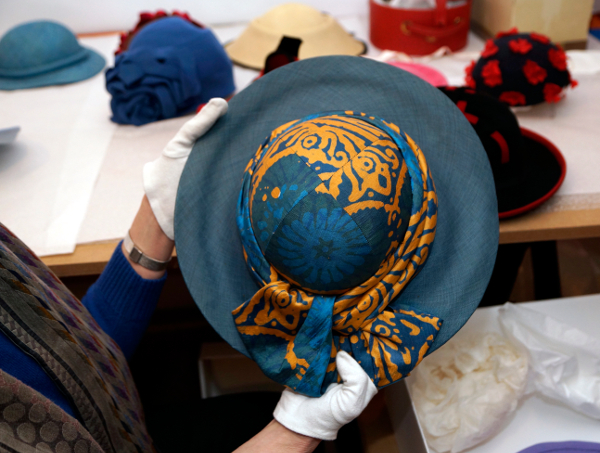
The exhibition shows at least one hat with a history like this, a hat which also features in the book ‘Dronningens Kjoler’ (The Queen’s Dresses) by Katia Johansen. It is in blue silk with a printed golden yellow pattern. The material was a gift from the Queen’s husband, Prince Henrik, who brought it home to her from his travels to Iran 1975 or 1976. The Queen had a blouse made of out it and a turban hat, together with a suit in warm yellow. Later, the hat was re-made into its actual form: low-domed crown with a shawl-like garnishing around it and a blue straw, slightly upturned brim. She wore this ensemble twice in 1979 on state visits – a Danish state visit to China and a British state visit to Denmark.
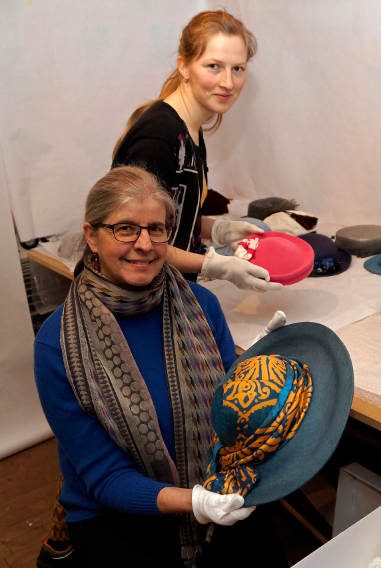
Curator Tove Engelhardt Mathiassen and her assistant highlighting this blue hat with impeccable crown stitching and ruched hatband (its original turban form still visible!)
Queen Margrethe with Queen Elizabeth during the May 1979 British state visit to Denmark
MUCH MORE FUN TO LOOK UGLY
Later still, the blouse’s Persian silk ended as part of the antependium, altar cloth, of the bishopric of Haderslev in Southern Denmark. Many of the Queens’ clothes and accessories ended their lives either as religious garments for Danish clerics or theatre dresses for the pupils of dancing school Fru H’s Danseinstitut led by the Queen’s friend Susanne Heering. This fits very well for the Queen as one of her main hobbies is designing costumes for the stage. For a while, designing clerical garb was her hobby, too.
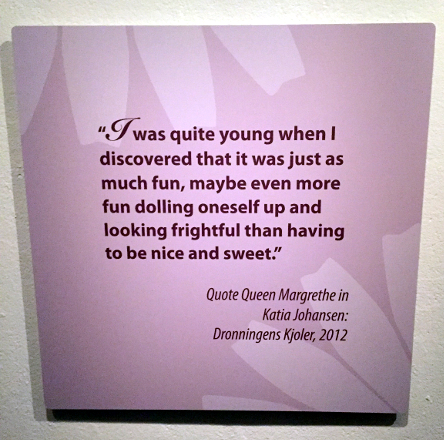
It is interesting to note that the Queen has said that early on in life, she discovered that she found it much more fun to dress up in a way that is NOT pretty or sweet, but rather the opposite. Theatre design gave her a much better outlet for that than her own ’working’ clothes (and hats). Although the Queen’s boundary-breaking, Pippi Longstocking-kind-of-approach to fashion never is far away.
Inger- this approach to fashion by Queen Margrethe now explains several of her unusual (and sometimes bizarre) hats! Stay tuned tomorrow, dearest readers, for the second part of this fantastic exhibition review and look back at Queen Margrethe’s hats. My sincere thanks, again, to Inger Stokkink.
Photos from Miguel Mielgo and Inger Stokkink may not be replicated in any way without written permission.

Queen Margrethe in her repeated black felt hat with fur cuff bumper brim for her return to official duties this week, presenting the “Queen’s Clock” military honour on Wednesday (Royal House of Denmark)
Princess Beatrice and Princess Eugenie in casual fedoras in this undated photo shared last Sunday by their mum (Sarah Ferguson instagram)
The following new millinery designs caught my eye this week:
Dramatic red and cream stripes on this oversize picture hat from NY based milliner Anya Caliendo
Black and white crin design with lace applique trim from Italian milliner Giulia Mio
Stunning straw teardrop perchers in pale pink and shocking pink from British milliner Rosie Olivia
Vivien Sheriff’s take on a brown fedora- chic, wearable and miles away from boring!
Pyramid disc covered in pleated Petersham ribbon in the loveliest shade of blue from Canadian milliner Helen Gair
Delicately beautiful pink straw calot with flower and birdcage veil from UK milliner Laura Cathcart
Red leather percher with giant white bloom from Tasmanian brand Cessiah Alice Millinery
Interesting cloche variation in black straw from Dutch milliner Myra van de Korput
Simple but beautiful hand draped turban in luminous blue straw from Queensland based Leigh millinery
Striking, chic and oh-so wearable burgundy fedora in fur felt from UK milliner Camilla Rose (love the feathers!)
And from Brisbane based milliner Marilyn Van den Berg, this cream straw disc with twist and stunningly realistic spring flowers. This is the kind of hat I dream about wearing to Royal Ascot.

Congratulations to Princess Mabel who was awarded the Geuzen Medal 2018 for her inspiring leadership and committment to end childhood marriage globally.
Prince Christian of Hanover and Alessandra de Osma celebrated their religious wedding in Peru yesterday. There were no hats but head over to the Royal Order of Sartorial Splendor for a great review of the bride’s dress and tiara.
Princess Charlene shared these charming snaps of Princess Gabriella and Prince Jacques helping their father, Prince Albert, celebrate his 60th birthday this week.
Hola magazine reports there will be wedding bells this summer in Monaco with the marriage of Charlotte Casiraghi and Dimitri Rassam. No formal confirmation has been released yet.
Such a fun portrait of Princess Camilla of Bourbon Two Sicilies with her daughters, Princess Maria Carolina and Maria Chiara
Sweet snap shared last Sunday by Princess Madeleine of Princess Leonore and Prince Nicolas meeting their new sister, Princess Adrienne
 Royal Hats