

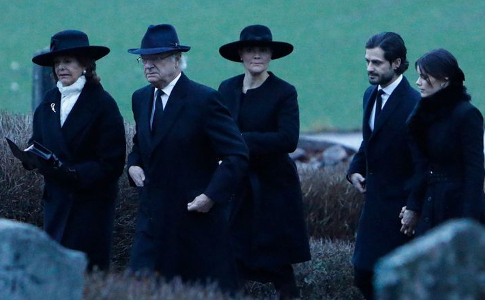
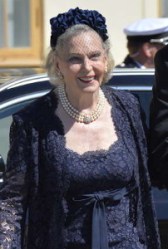
Queen Silvia and Crown Princess Victoria wore brimmed hats last Sunday to the funeral of Count Oscar Bernadotte; Princess Sofia wore a black hair bow and snood. You can see the hat and headpiece worn by Dagmar Von Arbin (née Countess Bernadotte of Wisborg) and Countess Marianne Bernadotte here.
Princess Anne and Vice Admiral Laurence were in Chile last weekend to take part in a number of events to mark the Bicentenary of the Chilean Navy.
A preview of the Swedish royal annual documentary shows the Crown Princess and her family enjoying summer in several casual hats.
On Wednesday, Emperor Akihito and Empress Michiko attended the 50th anniversary ceremony of the Sharoushi Act in Tokyo. The Empress repeated a small grey rimmed saucer hat with layered silk bow.
Princess Masako celebrated her 55th birthday today with a visit to the Imperial Royal Palace. She wore a repeated robin’s egg blue rounded pillbox for the visit.
Royal milliner Rose Cory, who made many of the late Queen Mother’s hats, was awarded an MBE this week at Buckingham Palace
The following new millinery designs caught my eye this week:
Black wave-shaped saucer trimmed with autumn leaves by Italian milliner Giulia Mio
Forest green cloche with ruffled brim ’round the back by British brand Whiteley
Wonderfully chic wide brimmed, tri-colour straw Panama hat by Australian milliner Neil Grigg
Adore the unique shape on this blocked bright pink hat shared by British milliner Tracy Chaplin
Veiled black felt hat with layered mushroom brim by Russian milliner Lia Gureeva
Button perchers with veil and pompom embellishment from British milliner Rachel Trevor Morgan
Very handsome navy blue fedora with ribbon hatband and feather trim from British brand Christys
Angular chocolate felt hat and snappy plaid crin hatband by Czech milliner Jolanta Kotabova
Sideswept picture hat covered in coral ostrich feathers by British milliner William Chambers
Slightly bonkers sisal boater covered in flowers and 3D polka dots by California milliner Amy Fowler
Forest green cloche with ruffled brim ’round the back by British brand Whiteley
Wonderfully chic wide brimmed, tri-colour straw Panama hat by Australian milliner Neil Grigg
Adore the unique shape on this blocked bright pink hat shared by British milliner Tracy Chaplin
Veiled black felt hat with layered mushroom brim by Russian milliner Lia Gureeva
Button perchers with veil and pompom embellishment from British milliner Rachel Trevor Morgan
Very handsome navy blue fedora with ribbon hatband and feather trim from British brand Christys
Angular chocolate felt hat and snappy plaid crin hatband by Czech milliner Jolanta Kotabova
Sideswept picture hat covered in coral ostrich feathers by British milliner William Chambers
Slightly bonkers sisal boater covered in flowers and 3D polka dots by California milliner Amy Fowler
And from Irish millinery brand Angels and Insects, this red velvet blocked percher trimmed with luxuriously beautiful scarlet velvet and silk dahlia blooms and green leather leaves. LOVE.

Charming new portrait of Princess Ingrid and Prince Sverre on the occasion of the prince’s 13th birthday
Princess Madeleine shared this sweet snap of Princess Leonor’s ballet debut in The Nutcracker
Photos from BestImage and social media as indicated

 Royal Hats