This Week’s Extras

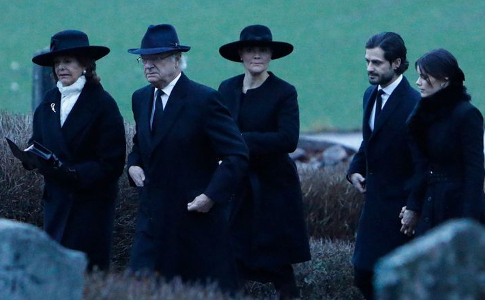
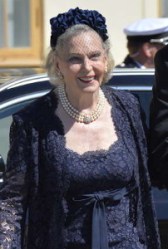
Queen Silvia and Crown Princess Victoria wore brimmed hats last Sunday to the funeral of Count Oscar Bernadotte; Princess Sofia wore a black hair bow and snood. You can see the hat and headpiece worn by Dagmar Von Arbin (née Countess Bernadotte of Wisborg) and Countess Marianne Bernadotte here. 
Princess Anne and Vice Admiral Laurence were in Chile last weekend to take part in a number of events to mark the Bicentenary of the Chilean Navy.
A preview of the Swedish royal annual documentary shows the Crown Princess and her family enjoying summer in several casual hats.
On Wednesday, Emperor Akihito and Empress Michiko attended the 50th anniversary ceremony of the Sharoushi Act in Tokyo. The Empress repeated a small grey rimmed saucer hat with layered silk bow.

Princess Masako celebrated her 55th birthday today with a visit to the Imperial Royal Palace. She wore a repeated robin’s egg blue rounded pillbox for the visit.

The following new millinery designs caught my eye this week:
Black wave-shaped saucer trimmed with autumn leaves by Italian milliner Giulia Mio
Forest green cloche with ruffled brim ’round the back by British brand Whiteley
Wonderfully chic wide brimmed, tri-colour straw Panama hat by Australian milliner Neil Grigg
Adore the unique shape on this blocked bright pink hat shared by British milliner Tracy Chaplin
Veiled black felt hat with layered mushroom brim by Russian milliner Lia Gureeva
Button perchers with veil and pompom embellishment from British milliner Rachel Trevor Morgan
Very  handsome navy blue fedora with ribbon hatband and feather trim from British brand Christys
Angular chocolate felt hat and snappy plaid crin hatband by Czech milliner Jolanta Kotabova
Sideswept picture hat covered in coral ostrich feathers by British milliner William Chambers
Slightly bonkers sisal boater covered in flowers and 3D polka dots by California milliner Amy Fowler

And from Irish millinery brand Angels and Insects, this red velvet blocked percher trimmed with luxuriously beautiful scarlet velvet and silk dahlia blooms and green leather leaves. LOVE.

Charming new portrait of Princess Ingrid and Prince Sverre on the occasion of the prince’s 13th birthday
Princess Madeleine shared this sweet snap of Princess Leonor’s ballet debut in The Nutcracker

Photos from BestImage and social media as indicated
Dutch Queen Opens New Charity Headquarters

Queen Máxima opened a new environmentally sustainable office building for a group of Charity Lotteries in Amsterdam yesterday. For this visit, she wore a new toque hat in the same saffron yellow and navy silk ikat print as her blouse.


There’s lots going on here to balance the ensemble: the reversed pattern of the silk print on the skirt,  the small-ish scale of the hat, the open funnel neck of the blouse, the high contrast yellow and navy colour scheme. It’s a very coordinated look to be sure, but I think it works well and I admire Máxima for stepping out in a colour as strong as this yellow- not something we often see on a royal hat. 

Previously Worn: this hat is new

What do you think of this new toque hat?
Photos from Getty as indicated

Danish Visit to Latvia

Crown Prince Frederik and Crown Princess Mary of Denmark arrived in Riga today where they were welcomed by Latvian President Raimonds Vejonis and his wife Iveta Vejone. For the start of this visit, Princess Mary wore a new domed pillbox hat covered in the same finely woven pink tweed as her embellished coat.

Embed from Getty Images

I think a streamlined hat is usually the right choice to pair with an embellished coat but I’m a bit meh about this design- the domed shape of the crown pulls the hat into calot territory where it looks a little clunkier than if the shape had remained flat, like a classic pillbox. The coat is the star here, which is fine, except I have to wonder what’s the point of wearing a hat at all if it’s not going to elevate the overall look? From the side view, I’m really not sure this one does…  I’m hoping you’ll convince me otherwise. The colour is awfully pretty on Mary, but I’m just not sure about the shape.

https://www.instagram.com/p/BrD0H3NgnBy/
https://www.instagram.com/p/BrDUx-wAqXR/
https://www.instagram.com/p/BrD0FZmg92B/

Designer: likely Susanne Yuul
Previously Worn: This hat is new
What do you think of this new Danish hat’s debut in Latvia today?
Photos from Getty as indicated

Guest Post: Musings On The Kokoshnik

I’m pleased to welcome reader Eliska to Royal Hats. She is a a writer, retired ballerina, actor, member of the International Dance Council (CID) and enthusiastic royal hat follower who contacted me several weeks ago with an interesting theory about a style of royal millinery that has gained in popularity this year.

When the Duchess of Cambridge appeared in the wedge shaped headpiece to christening of her newborn son, Prince Louis, my historical costume antennas went, “Aha!” As someone who studied art history, she is obviously very well informed of all things of the royal past- fashions included. Or should I say ‘Fashion in the First place’, since that is how we perceive history- through the visual information given to us through old portraits and photographs.

Embed from Getty Images

This year we commemorate a hundred years since the end of WWI, or The Great War, as Churchill named it, without any doubt that this was the last one ever. It was also the tragic anniversary of the Romanov murder. Portraits of all Russian princesses, in summer white, including the headpiece, the kokoshnik, were to be seen all over media.

Embed from Getty Images

As the year progressed, I started noticing more than usual appearance of the kokoshnik, as a new headpiece choice, all over European aristocratic circles; at weddings, family gatherings, christenings. It was as if European aristocratic circles suddenly rediscovered this type of headpiece.

Embed from Getty Images Embed from Getty Images
 

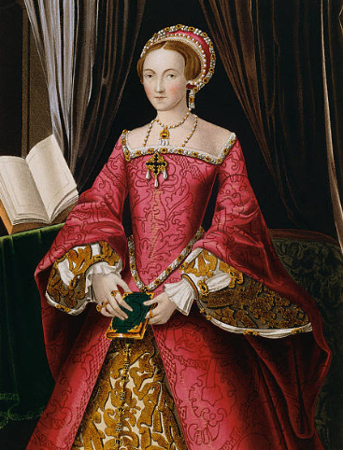
An intriguing question started taking shape in my mind: Is the sudden appearance of this headpiece an inconspicuous nod to the genetic ties and loyalty of royal Europe to the Romanovs? The quiet aristocratic, diplomatic “we will-not-forget”?Of course you can counter this with portraits of Tudor Queens. Holbein painted all of them garbed in the finest fashions of his time, their headpieces closely resembling those of Russian folk costumes.

Elizabeth Tudor by Hans Holbein c. 1546-7. The Royal Collection, Windsor Castle

However, I see it as hardly any coincidence that this year, of all years, Royal brides of royal Europe chose the kokoshnik shape as their tiara of choice.

Embed from Getty Images Embed from Getty Images

Looking at videos, you can see many of aristocratic ladies with headpieces of that choice. Pure chance? Perhaps. Let me recapitulate a few historical facts for you: kokoshnik: the headpiece of Russian folkdress, abolished at Russian court by the Tzar Peter the Great who saw the imminent need to change his aristocrats to more Western looking, presentable group. Beards and kokoshnik had to go.

Embed from Getty Images

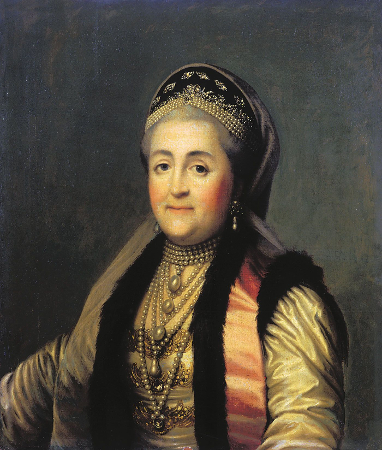
As time went by, another Russian monarch, the German born Princess Sophie Anhalt-Zerbst, renamed Ekaterina Alexejevna on her marriage into Romanov dynasty, became known as Catherine The Great. Her new country was also introduced to all things Western but she had a different aim than Peter the Great. In a move to befriend the vast Russian populous, she sat for a famous portrait wearing, you guessed it, a traditional kokoshnik.

Portrait of Empress Catherine II by Vigilius Erichsen, c.1770. State Hermitage, St. Petersburg

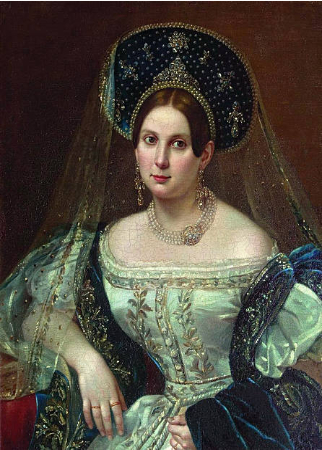
Whether or not this fashion strategy worked in Catherine’s political favour, that’s another essay to write. Two generations after the above portrait was painted, Napoleon attempted to defeat Russia. The French invasion of Russia in 1812 awoke the nationalist loyalty and inspired the Russian aristocracy emphasize their Russian roots. An immediate, easy way to do this was through fashion; quickly, the kokoshnik returned to court as part of mandory dress and was included as part of the coronation robes of every Russian Empress from then forward. With immense personal connections through the royal circles of Europe, the resurgence in popularity of the kokoshnik spread beyond Russia’s borders and soon the headpiece became “à la mode”. 

Portrait of a woman in the Russian court dress by Orlov, Pimen Nikitich, c.1835. State Hermitage, St. Petersburg

So, back to my theory: Have the aristocratic ladies of Europe sent a loving nod to the unfortunate late family this year? It is up to you, kind reader, to decide. I just thought it would be interesting to elaborate on that idea. While my theory may be debated, the crescent shaped headpieces made many a fashion statement this year; The kokoshnik has resurfaced from obscurity again. Well done, ladies! (Curtsy)

Embed from Getty Images
Thanks, Eliska! So readers- what do you think?
Photos from Getty as indicated; The Royal Collection; and State Hermitage, St. Petersburg

Queen Opens Children’s Charity Facility

Queen Elizabeth opened a new facility at the ‘Coram’ children’s charity  in London this morning. Established in 1739 by Thomas Coram, the charity was the first home in London to care for abandoned babies and vulnerable children. For this visit, the queen repeated her teal blue wool hourglass shaped cloche hat trimmed with black velvet flowers and leaves.

Embed from Getty Images Embed from Getty Images

We saw this hat less than a month ago so there’s not much to say about it except that it’s great to see the teal, white, purple and black print of the dress of this ensemble (see gallery on the right, above). I also find the frequency of this repeat a bit unusual- usually, the Queen spaces out repeated wearings further.
Embed from Getty Images
Designer: Angela Kelly. Coat by Stewart Parvin.
Previously Worn: Nov 7, 2018; Jan 31, 2017Oct 23, 2017; Dec 3, 2015; Apr 2, 2015Oct 16, 2014
Thoughts?
Photos from Getty as indicated