Imperial Royals Celebrate Daijosai

On Thursday and Friday, enthronement rituals concluded with The Daijosai (Great Thanksgiving Ceremony), a festival that dates back to at least the 7th century and is performed by a new emperor the autumn following his enthronement. This festival was held in temporary Shinto shrine compound called the Daijokyu, composed of nearly 30 buildings (about 6,500 square meters) specially built in the East Gardens of the Imperial Palace grounds for the Daijosai. For those of you in Tokyo, this will be opened to the public free between November 21 and December 8 before being dismantled, the wooden building materials being recycled for parks and disaster-prevention facilities.

Embed from Getty Images

The Imperial Household Agency purchased specialty vegetables, fruit and seafood from each of Japan’s 47 prefectures for this festival. Rice was cultivated in two rice paddies in the country’s east and west with the locations determined by divination using turtle shells; special fabrics- hemp from Tokushima and silk from Aichi were also provided.

Embed from Getty Images

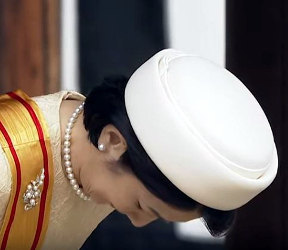
The day began with Empress Masako arriving at the royal palace (earlier than the emperor, to prepare her elaborate costume) in a cream silk jacquard printed bumper hat.


For the ritual, the emperor wore white sokutai robes with the distinctive black kanmuri hat.

Embed from Getty Images

The empress wore a traditional “junihitoe” multi-layered kimono, this one in white and peach, along with this Heian Era costume’s triple pronged silver headpiece.

Embed from Getty Images

The Imperial Princess (I’ve spotted Kiko, Mako, Kako and Nobuko and suspect the other Mikasa and Takamado princesses also attended) wore a similar metal headpieces but with more delicate, beaded triple prongs (following a tree shape, I think?) and silk cord that loops around the top of the head and hangs down in a multi-bowed tassel on either sides of the face.


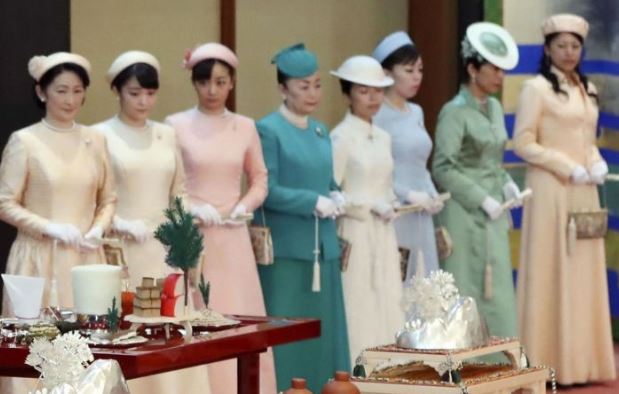
The event concluded with a banquet, hosted by the emperor and empress. The Imperial Princesses were in attendance, the Akishinos in cuffed calot hats, Princess Nobuko in a teal button percher, Princess Akiko in a brimmed cream hat, Princess Yoko in a pale blue percher, Princess Hisako in a green saucer with cream brim and flowers around the raised back, and Princes Tsuguko in a petal trimmed peach bumper.
Photos from Getty as indicated 

This Week’s Extras

Early last month, Princess Hisako and Princess Tsuguko took in events for the 74th National Sports Festival in a pair of pale hats. Princess Hisako also kicked this week off at the National Dietary Improvement Conference in Miyazaki in a very interesting hat with black brim and patterned burgundy silk crown and leaves at the side


Lady Kitty Spencer attended the Melbourne Cup Monday in a dark blue stemmed beret percher with leaf studded veil by Awon Golding and on Tuesday in a soaring brimmed black Stephen Jones creation.
Queen Sonja welcomed Slovenian president on a state visit on Wednesday in a powder blue and grey felt hat with cutouts across the front. At first glance, I thought it was a repeat but it’s new- and surprisingly close in appearance to its predecessor. 


Embed from Getty Images

Also on Wednesday, Empress Masako arrived at the Imperial Royal Palace (to rehearse the upcoming Daijosai ceremony) on Wednesday in her almond silk covered bumper hat. On Thursday, Princess Akiko wore a grey hat with interesting upfolded brim on a visit to Fujinomiya to open the 7th World Tea Festival. 


Queen Margrethe opened an exhibition on Germany yesterday at the Danish National Museum in Copenhagen. She repeated her deep purple felt hat with sidesweeping brim and side bow.
The following new millinery designs caught my eye this week:
Fantastic fuchsia textured straw pillbox with oversize, flying pink bow by Australian milliner Irene Moore
London-based Irish milliner Philip Treacy’s lavender velvet felt trilby with silk hatband and fringed bow
Black straw hat with beautiful bias folded brim and feather trim by Dutch milliner Myra van de Korput
Graphic royal blue cutout origami halo bandeau by Australian milliner Lauren Ritchie
Black felt percher with crin ruffle and black and white feathers by British brand Hostie Hats
Whimsical lilac straw pillbox with statement silk allium flower trim by Australian milliner Victoria Henderson
Angular purple felt hat with the most fantastic folded ribbon hatband by Spanish milliner Eugenia Jimenez
From Australian brand Jack and Jill Millinery, a cheeky yellow straw brimmed cap with horse bit trim
Simple black felt cloche made special with added applique floral vines. Made by US milliner Jennifer Hoertz
Red felt button percher with impressively sculpted trim by British brand Gillys Millinery
Shell-shaped percher hat in striped tan and pink silk abaca with feather by Spain-based milliner Donna Hartley
Incredible gold bandeau headpiece with ombre stacked feather plume by Australian milliner Wendy Scully

And from Australian milliner Jo Peterson, this black disc edged in pink crin with amazing string art trim.

This Week’s Extras

On Wednesday, October 23, Swazi King Mswati III and his newest wife, Inkhosikati LaMashwama arrived in Sochi to take part in the 2019 Russia-Africa Summit. Inkhosikati LaMashwama wore a magenta straw disc percher hat trimmed with straw twists, rosettes, feathers and sparkle crin bows
Embed from Getty Images
On Thursday, October 24, Princess Yoko wore a sunny, tall-crowned cloche to open the 46th Tokyo Motor Show. The same day, Princess Kiko wore a beige silk covered bumper hat with smocked side panel to open the Meiji Jingu Museum

Also on October 26, Queen Margrethe repeated her tan, caramel, chocolate and burgundy checked hat with short  brim and stacked hatbands for military awards and parades at Fredericia. Crown Prince Frederick wore a Tyrolean hat to host a hunt on the Gludsted Plantation in central Jutland on Monday, October 28.
The Imperial Princesses in hats on Monday for the 3rd court enthronement banquet. Last Sunday, a memorial for the Prince of Mikasa (Takahito) was held on the third anniversary of his death. Crown Princes Kiko, Princess Mako, Princess Kako, Princess Yuriko of Mikasa, Princess Akiko, Princess Yoko and Princes Tsuguko were all in attendance in demure black hats.

On Thursday, Queen Maxima repeated her warm brown straw picture hat with high upswept brim.
The following new millinery designs caught my eye this week:
And from British milliner, millinery instructor and millinery flower maker Ann Tomlin, this whimsically wonderful green button percher trimmed with a handmade wildflower garden. It’s just so charming.

Lovely new portraits of the Belgian royal family (see here, here and here) released last weekend for the celebration of Princess Elisabeth’s 18th birthday
The Norwegian and Greek royals shared inspiration for their Halloween costumes this year

Photos from social media as indicated

Imperial Enthronement: Ceremony

The main element in Tuesday’s Imperial Enthronement was the Sokuirei-Seiden-no-Gi, an official proclamation ceremony where the new emperor announces to domestic and foreign audiences that he has ascended the Chrysanthemum Throne.

Embed from Getty Images

This ceremony took place inside the Imperial Palace before a large audience. Emperor Naruhito again appeared in sokutai robes, this time in the dark rust-brown colour reserved for his role, and the distinctive black kanmuri hat.

Embed from Getty Images Embed from Getty Images
Embed from Getty Images

Empress Masako wore a traditional “junihitoe” multi-layered kimono which dates back to the Heian Era (794 to 1185). In white, silver, red, coral,  purple, pale peach and green, the kimono is regal and dramatic, especially paired with the the elaborate sculpted sweeping ponytail that is worn with this costume along with a triple pronged golden headpiece.

Embed from Getty Images

Crown Prince Fumihito wore saffron orange sokutai robes and a black kanmuri hat.

Embed from Getty Images

The Imperial princesses also wore the traditional junihitoe with Crown Princess Kiko in shades of red, pink, orange, gold, white and purple, with a top robe in slate navy and the others in layers of green, navy, red, burgundy, yellow and white with a top robe in royal purple. Each wore the traditional spiky gold headpieces atop the costume’s dramatic hairstyle.

Embed from Getty Images
Crown Princess Kiko

Embed from Getty Images
Princess Kako and Princess Mako

Embed from Getty Images
Princess Hanako

Embed from Getty Images
Princess Hanako and Princess Nobuko in front; Princesses Akiko, Yoko, Hisako and Tsuguko in back

On their own, these spiky headpieces and tall hats seem so unusual but somehow, they add to the grandeur and strong sense of history at these events.

Embed from Getty Images

Next up, we’ll look at the hats worn by royal guests.

Photos from Getty as indicated 
Imperial Enthronement: Morning Court Rituals

On Tuesday, the Enthronement of Emperor Naruhito took place with a series of ceremonies at the Imperial Palace in Tokyo. Empress Masako was spotted arriving at the palace early in the morning in a sleek,  unembellished bumper hat covered in a warm shade of ivory silk.

Embed from Getty Images

Designer: unknown
Previously Worn: uncertain. I think it may be same hat was worn May 7, 2019; Mar 20, 2019; Jan 7, 2019; Dec 27, 2018

The day began with the ‘Sokuirei-Tojitsu-Kashikodokoro-Omae-no-Gi’ ceremony held at the Kashikodokoro Shrine within the Imperial Sanctuaries where Emperor Naruhito ceremonially announced the enthronement ceremony, which would shortly follow. For this event, the emperor wore traditional sokutai robes in white linen specifically cultivated for this event and a tall, black kanmuri hat.


Empress Masako wore a white and peach jūnihitoe, a formal ancient kimono, with multiple (at least 12) complex layers. The traditional costume includes a specific and rather distinctive hairstyle and triple pronged silver headpiece, worn just over the forehead.

Embed from Getty Images


This ceremony was attended by Japanese Prime Minister Shinzo Abe, select government officials and members of the Imperial royal family. The imperial princesses followed a traditional court dress code of gowns with ivory hats.

Embed from Getty Images

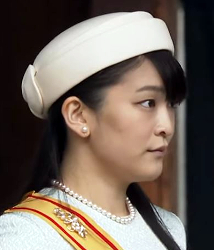
Princess Kiko, Princess Mako, and Princess Kako all chose bumper designs with slightly different brim shapes and trimming.

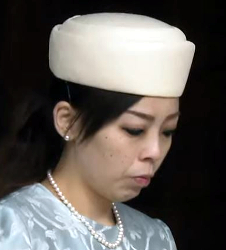
While Princess Yoko was also in a cream silk bumper hat, her sister, Princess Akiko made a slightly different statement in a pillbox with textured vertical pinstripes, trimmed with a slim band around the middle of the hat that tried in a bow at the back.

The most interesting hats were, again, worn by the Takamado princesses. Princess Hisako’s bumper variation featured less structured sides that draped into some lovely movement. Princess Tsuguko was the only one to wear a brimmed design, trimmed with a slim bow at the front.

While I understand that a string of ivory hats might not seem exciting to western fashion sensibilities, I think there’s something serenely compelling and regal about it.

Photos from Getty as indicated and Sankei News