to this day in 2006, 15 years ago, when the former Empress of Japan arrived for a state visit to Thailand in a large white saucer hat trimmed with the loveliest deep peacock blue silk flowers.
We wrap up Jake Short’s fascinating series on Hawaiian royal hats with a fifth and final installment today. Jake is a longtime Royal Hats reader and contributor and a very stylish hat wearer who you can follow on Instagram or Twitter. If you’ve missed his previous posts, link to all of them at the bottom. Immeasurable thanks, Jake for this fantastic series!
Claims To The Throne
Who is considered the heir to the Hawaiian throne nowadays is contested. Some consider Quentin Kūhiō Kawānanakoa, grandson of Abigail Kapi‘olani Kawānanakoa, to be the heir as his is directly descended from Prince David Kawānanakoa through primogeniture.
Abigail Kekau is the daughter of Lydia Lili‘uokalani Kawānanakoa pictured below, who was the younger sister of Abigail Kapi‘olani. Abigail Kekau was hānai adopted in 1932 by her grandmother Princess Abigail Campbell Kawānanakoa with the idea she would be direct heir, hence why it is argued she is the correct heir.
If Abigail Kekau was to succeed to a restored Hawaiian throne, she would be the world’s second-oldest monarch (Queen Elizabeth II is only two days older) and also the first openly lesbian queen. Abigail Kekau also served as president of the Friends of ‘Iolani Palace organization for almost 30 years.
Outside of the Kawānanakoa claims, Owana Ka‘ōhelelani Salazar asserts she is the true heir to the throne due to her family lineage and connections to the Royal School created by Kamehameha III in 1848. Before her death in 1988, Princess Helena Kalokuokamaile Wilcox named her daughter Owana and Owana’s son Noa as her direct heirs. Neither Abigail Kekau nor Quentin Kawānanakoa seem very interested in pursuing monarchical restoration; in contrast, Owana does so intentionally by interacting with other deposed royal houses from around the world, and bringing back the Hawaiian royal orders (although thus far not wearing royal hats, or at least not any I could find).
Japanese Imperials In Hawai‘i
Remember there was the possibility of a Hawaiian princess marrying into the Japanese Imperial Family? Despite never happening, there have been many Japanese immigrants to Hawai‘i in the last two centuries, and there is still a strong bond with Japan. As such, members of the current Japanese Imperial Family have visited Hawai‘i on several official occasions, often wearing hats.
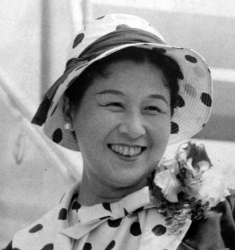
On his way to attend the coronation of Queen Elizabeth II in 1953, then-Crown Prince Akihito visited Hawai‘i wearing a smart fur felt fedora. 1960 saw a visit from Nobuhito, Prince Takamatsu, and Kikuko, Princess Takamatsu (uncle and aunt of Akihito); Nobuhito carried a fur felt fedora, while Kikuko arrived in a polka dot cloche with simple sashed hatband.
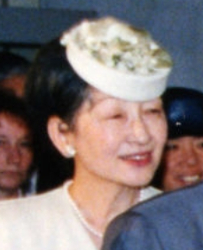
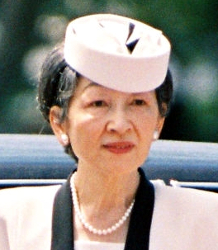
Later that day and the next, she wore a pair of her signature pillbox percher hats. Both in ivory, the first was a shorter version covered in ivory silk flowers and avocado silk leaves. The taller design, worn June 24, 1994, was trimmed in an ivory and black bow to match her suit.
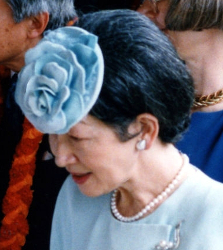
The following day, June 25, 1994 saw two hats on the Empress: first a pale blue small disc hat with a large rose trim, and then a very wide disc hat with a rose and leaves trim on the front when they departed.
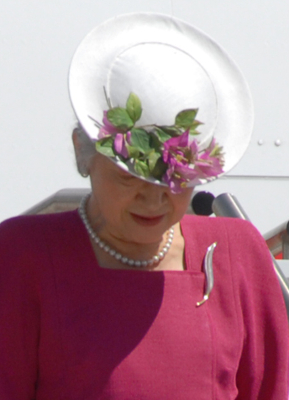
A final visit in 2009 saw another wide disc hat trimmed with a large navy blue silk bow, along with one of my favorite all-time hats for Michiko: this wider disc hat with flowers and leaves that coordinates perfectly with her raspberry and black outfit.
During a 2018 visit to Honolulu with Prince Akishino, Princess Kiko wore a simple and sophisticated navy blue straw hat and the couple were photographed in Hawaiian leis.
With the overthrow of the monarchy, the once strong connections with British royal family all but vanished (Hawai‘i’s flag does include the Union Jack due to these historical ties). But Hawai‘i has seen a few visits from the British royals since it became a U.S. state. On 27 March 1963, Queen Elizabeth II and Prince Philip were greeted by then-Governor John Burns; the Queen wore a smaller Breton-style hat during this visit
It remains a sad part of history the Kingdom of Hawai‘i is no longer with us today for many reasons, including for us at Royal Hats not having more possible hats to admire. With decades of close relations with the British, one can only imagine what those may have looked like today; would Hawai‘i be part of the Commonwealth today? Or what if deeper connections with the Japanese Imperial Family had been pursued further? (This is especially interesting when you consider how a continuing independent Hawai‘i or a Hawai‘i as head of a Polynesian federation would’ve changed the course of history, including WWII.)
While the number of hats sported by Hawaiian royals was not vast, it is much more numerous than one might expect, and that’s of course only what was photographed at the time. As a final additional side note, the Daughters of Hawai‘i, a group dedication to the historic preservation of Hawaiian royal palaces, have been seen many times wearing all-white ensembles, including white portrait hats.
I have not visited Hawai‘i yet, but I hope to one day get there and see places of historical importance like the ‘Iolani Palace. Have you been to Hawai‘i? Were you aware of all this history? I hope you’ve enjoyed this unique look at the Royal Hats of Hawai‘i as much as I did discovering them.
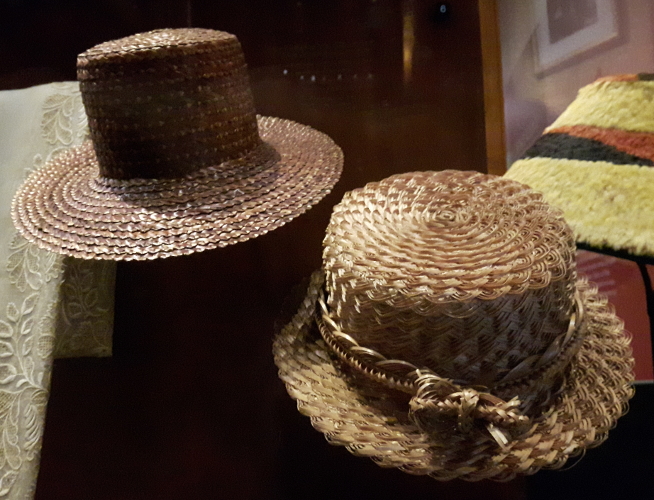
Thank you Jake, for all of the research and thought put into this series. It has been insightful, engaging and educational. I have one thing to add- a photo I took in 2017 at The Bernice Pauahi Bishop Museum, designated the Hawaiʻi State Museum of Natural and Cultural History, in Honolulu. These hats were from the Hawaiian Royal Collection- I’m afraid, at the time, I was more intrigued by the beautiful and intricate woven pattern than I was at who had worn them. If anyone has further information they can share, please do!
Stay tuned later this summer for another series from Jake! His previous guest posts at Royal Hats include:
I liked today’s placement of this design, curved further forward as a bandeau than in the further back, almost calot position she has worn it on previous outings. It also pairs well with this border print dress (although I could loose the cartoonish belt!), the print keeping the look from falling into boredom. However, while the headpiece looks fine at a distance, closeup view shows pinches and puckers around the edges of the padded leaves, something that could have been avoided and yielded a more polished look..
She chose a suitably vibrant and whimsical ensemble for the occasion, topping a pink trouser and tunic with her textured orange straw hat with sharply diagonal sideweeping slice brim.
It’s a bold look that pulls together with Máxima’s jewelry and patterned pashmina and makes her stand out it a crowd. In some lighting, the hat takes on a pink hue from the tunic, further mellowing the look. It’s the most unexpected ensemble we’ve seen paired with this hat!
Prince Constantijn and Princess Laurentien of the Netherlands celebrated their 20th wedding anniversary earlier this month, a milestone which warrants a look back at their nuptials.
Constantijn and Laurentien’s circles overlapped years before they decided to marry, Laurentien’s mother Jantien a school friend of Queen Beatrix and her father, Laurens Jan Brinkhorst, a prominent Dutch politician and diplomat (and, ironically, vocal proponent of a smaller Royal House and reduced political role of the Head of State). The couple, who then resided in Brussels, returned to The Hague for their three day wedding celebration: civil marriage on May 17, 2001, gala dinner dance at Palace Noordeindeon May 18 and religious ceremony on May 19. Laurentien turned to Edouard Vermeulen of fashion house NATAN for all of her wedding attire.
She arrived at Oude Raadzaal (Old Town Hall) for the civil ceremony in a watermelon pink belted coat and dress topped by a lavender-grey hat with upfolded halo brim. Trimmed simply with a hatband in the same straw, the hat’s focal point was a pronounced brim pleat over Laurentien’s left eyebrow.
It’s always hard to regard past looks objectively- at the time, I was awed by the dramatic shape of this hat and thought the look to be bold and confident.
Queen Beatrix wore an ivory straw flat crowned hat with wide layered pink and ivory folded straw hatbands and a pink upturned Breton style brim that beautifully set off her ivory coat and pink accessories.
Laurentien’s mother Jantien topped her pale cornflower blue suit in a matching hat in the most unique shape – a sort of pillbox with pointed crown over which lay a slanted downturned brim – trimmed with a long quill. The hat’s scale and shape worked so well with the open collar on her jacket.
Máxima Zorreguita, who would marry Prince Willem-Alexander nine months later, wore a grey straw hat with jauntily upturned brim on the right side. The hat was trimmed in a dark taupe hatband and bound brim (notice the matching clutch!) and an oversize grey flower with lime leaves and curled feather staments that curved around the left side of the design. Interestingly, the hat would reappear two years later on a visit to Brazil with smaller brim and trimming. I prefer this original version.
Princess Margriet topped her blush suit with a wide brimmed black sinamay hat with tall ruched hatband around the shallow, rounded crown and a relaxed, fluted brim.
Princess Annette wore a cream hat with straight-sided, domed crown and mushroom shaped brim with side embellishment. I’ve not been able to locate a photo of Princess Marilene.
Twenty years on, which of these hats best represents fashion of the time? Which one stands out to you most?
We’ll continue with a look at the religious ceremony later this week.

 to this day in 2006, 15 years ago, when the former Empress of Japan arrived for a state visit to Thailand in a large white saucer hat trimmed with the loveliest deep peacock blue silk flowers.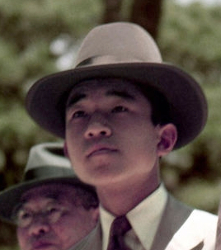

 Prince Constantijn and Princess Laurentien of the Netherlands celebrated their 20th wedding anniversary earlier this month, a milestone which warrants a look back at their nuptials.
 Royal Hats